BRICS vs G7: who actually has more economic power?
Talk of the death of the dollar mixes three separate stories: rising BRICS economic power, slower G7 growth, and a push for payment tools that reduce reliance on the U.S. dollar. The data supports a more multipolar economy. It does not support an imminent dollar collapse. This page compares the two blocs measure by measure, using primary sources, and separates what is documented from what is only argued.
No card payments, no pressure, no commissions-first pitch
GDP at PPP
BRICS larger (~39% of world, 2023)
Nominal GDP
G7 larger, at market rates
FX turnover
Dollar on 89.2% of trades (BIS, 2025)
Intra-BRICS exports
$84B (2003) → $1.2T (2024), UNCTAD
The two blocs are not the same kind of group
The G7 is an informal group of advanced economies — Canada, France, Germany, Italy, Japan, the United Kingdom and the United States, with the EU participating in its work. BRICS began as Brazil, Russia, India, China and South Africa and has expanded; official BRICS material from Brazil's 2025 presidency lists eleven full members, including Saudi Arabia, Egypt, the UAE, Ethiopia, Iran and Indonesia, whose full membership was announced on 6 January 2025. The G7 is smaller but far more aligned in law, finance and policy. BRICS is larger and more diverse, which gives it demographic and commodity weight but makes coordinated monetary action much harder.
G7: seven advanced economies, deeply integrated financial systems
BRICS: eleven full members spanning democracies, monarchies, one-party and sanctioned states
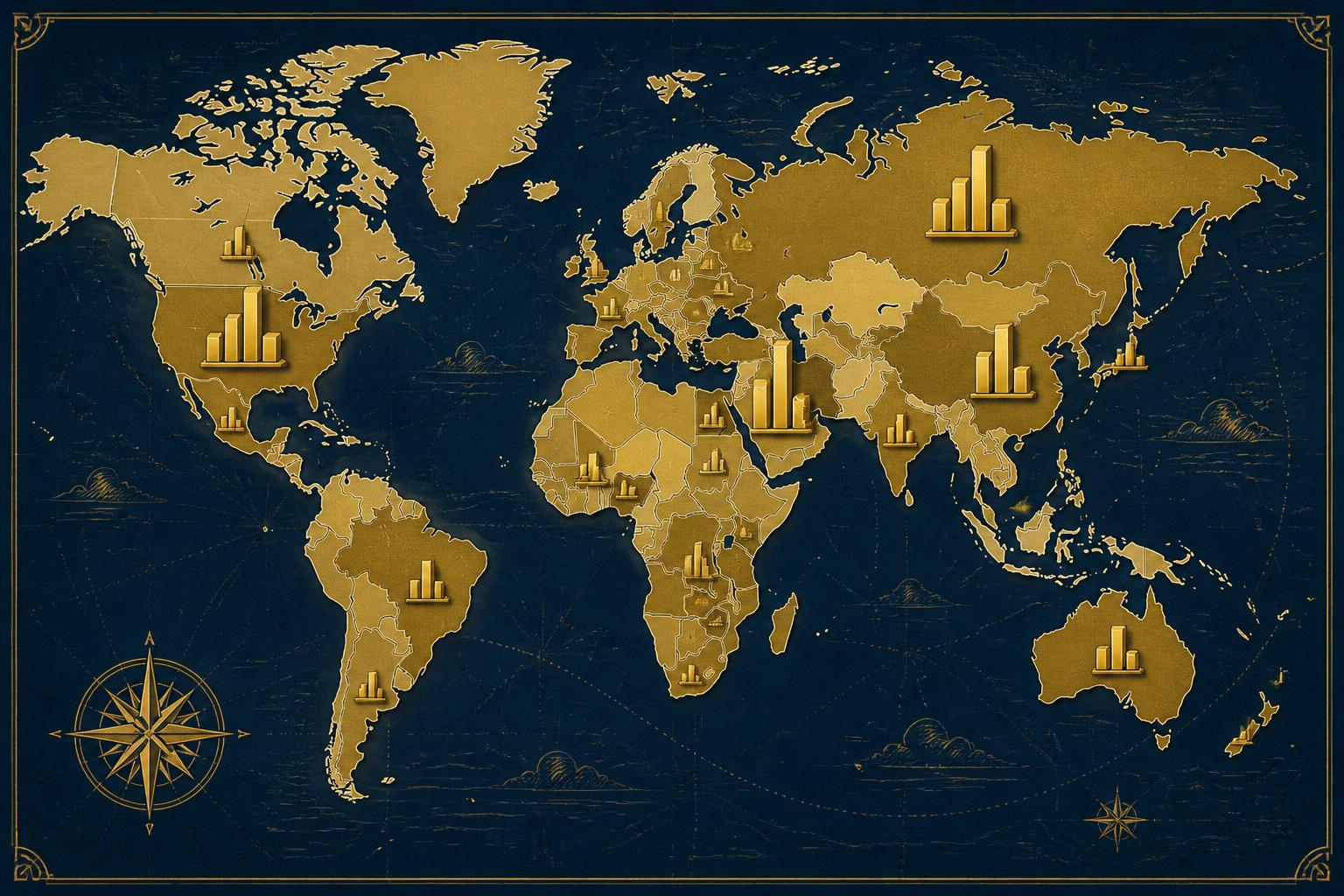
Where official gold sits. A picture of holdings, not a forecast of prices.Describe this illustration: World map shading countries by the reported size of their official gold reservesHide description: World map shading countries by the reported size of their official gold reserves
Where official gold sits. A picture of holdings, not a forecast of prices. This original Capstone Metals map illustrates world map shading countries by the reported size of their official gold reserves. It is educational artwork, not a price forecast, performance record or recommendation.
BRICS vs G7 GDP PPP: why the answer flips with the measure
Purchasing-power parity adjusts for local prices, so it shows how much real production and domestic activity an economy supports. On that measure the expanded BRICS bloc is larger than the G7 — official BRICS material put the bloc near 39% of global GDP in PPP terms for 2023, and IMF-based readings for 2026 place expanded BRICS in the high-30s against the G7 in the high-20s. At market exchange rates the ranking reverses: the G7 remains substantially larger, because its members have high-income currencies and larger dollar-value output. Both statements are true; quoting one as the whole answer is how misleading headlines get built.
PPP GDP favours BRICS — real domestic scale
Nominal GDP favours the G7 — financial capacity at market rates
Population strongly favours BRICS; per-capita income favours the G7
Financial depth favours the G7, and the United States in particular
An asset that cannot be switched off by another country's payment system behaves differently in a crisis.Describe this illustration: Illustration of a reserve account marked inaccessible beside a vault of physical metal marked availableHide description: Illustration of a reserve account marked inaccessible beside a vault of physical metal marked available
An asset that cannot be switched off by another country's payment system behaves differently in a crisis. This original Capstone Metals illustration illustrates illustration of a reserve account marked inaccessible beside a vault of physical metal marked available. It is educational artwork, not a price forecast, performance record or recommendation.
Why nominal GDP still anchors G7 financial power
Global finance clears in market currencies, so the ability to borrow, lend, invest abroad, insure trade and supply safe assets tracks nominal income and institutional trust. The United States has the largest government bond market and the deepest funding market in the world; the euro area adds a second large pool of high-grade assets, and Japan, the UK and Canada add trusted institutions. BRICS financial capacity is far more uneven — capital controls, sanctions, governance concerns and internal rivalry all limit the bloc's ability to behave as one financial power.
Payment rails, not slogans, are where de-dollarisation would actually show up.Describe this illustration: Diagram of cross-border payment routes with an alternative settlement path drawn alongside the dominant oneHide description: Diagram of cross-border payment routes with an alternative settlement path drawn alongside the dominant one
Payment rails, not slogans, are where de-dollarisation would actually show up. This original Capstone Metals diagram illustrates diagram of cross-border payment routes with an alternative settlement path drawn alongside the dominant one. It is educational artwork, not a price forecast, performance record or recommendation.
Trade: the strongest part of the BRICS case
UNCTAD's 2025 Trade and Development Report records BRICS merchandise imports rising from almost $800 billion in 2003 to roughly $5 trillion in 2024, with intra-BRICS exports rising from $84 billion to $1.2 trillion over the same period. That is not a bloc on the edge of the system; it is a bloc inside global supply chains with growing internal demand. Repeat trade between the same partners is exactly the condition under which local-currency settlement becomes practical. Trade scale alone, however, does not create a reserve asset — savings still need somewhere deep and liquid to sit.
Repeat corridors make non-dollar settlement cheaper to operate
Trade weight ≠ reserve-currency status
Energy and critical minerals: real leverage, limited monetary effect
The expanded bloc includes Russia, Saudi Arabia, Iran, the UAE and Brazil as major producers, plus China and India as major buyers, so energy trade creates repeat settlement flows and sovereign savings. On minerals, USGS data shows China as the leading rare-earth mine producer, with China and Brazil among the largest reserve holders. That matters for electric vehicles, wind power, semiconductors and defence supply chains. But reserves are not the same as supply-chain control — separation, refining and magnet production decide that — and settling some oil in local currency does not build a reserve system, because sellers still care about what the proceeds can be hedged and invested in later.
Energy exporters can request non-dollar settlement in selected corridors
China leads rare-earth mining and, more importantly, processing
Processing capacity, not geology alone, is the real chokepoint
"The petrodollar is dead" overstates what settlement changes achieve
Gold: a genuine signal with hard limits
Central banks keep buying gold for one plain reason — it is nobody else's promise to pay. A bond depends on an issuer, a deposit on a bank; gold sits outside that chain, which makes it useful to institutions worried about sanctions, debt and fragmentation. That is a real de-dollarization signal. It is not evidence of a gold-backed BRICS currency: gold pays no interest, costs money to store and protect, swings in price, and cannot by itself support global credit creation or a modern payment network.
No counterparty and no issuer risk
Attractive precisely when reserve assets can be frozen
No yield, real storage and insurance cost, volatile price
Cannot function alone as payment infrastructure
What a BRICS payment system does and does not do
Official texts are more careful than the headlines. The 2024 Kazan Declaration backed stronger correspondent-banking links inside BRICS, local-currency settlement, the BRICS Cross-Border Payments Initiative, and study of BRICS Clear as a settlement and custody system. Brazil's 2025 presidency explicitly played down a near-term common currency. The distinction is worth holding onto: a payment system moves money, a reserve currency gives the world an asset to hold, and a common currency requires shared monetary policy, fiscal trust and crisis tools. The plausible path is more local-currency invoicing in specific corridors — not a replacement currency.
Correspondent-banking links and local-currency settlement: under way
BRICS Clear settlement/custody: discussion stage
Common BRICS currency: not issued, and played down by members
Effect: dollar use trimmed at the margin, not displaced
Why a common BRICS currency is unlikely near term
The euro took decades of treaties among far more aligned economies, and still needed crisis machinery. BRICS members would have to answer who runs the central bank, who absorbs losses in a crisis, whether capital controls are permitted, what happens when one member runs high inflation, and whether China's size would dominate. China and India are rivals as well as partners, Russia and Iran are sanctioned, and members differ sharply on inflation history, debt and convertibility. These are questions of monetary sovereignty, not technical detail.
How to read this data without being misled
Six habits keep the comparison honest, and they are the same habits that keep an investment decision honest. INFERENCE, stated plainly: BRICS economic power and continued dollar dominance are both true at once, and the more defensible expectation is less automatic dollar use rather than the dollar's disappearance.
Separate PPP from nominal GDP — they answer different questions
Separate trade scale from financial depth
Separate payment rails from reserve currencies
Separate de-dollarization from dollar collapse
Watch reserves, issuance, invoicing and FX turnover, not summit language
Ask who absorbs the loss when a system is stressed
Rather just ask someone?
A specialist can answer this in two minutes. Monday – Friday, 7am – 4pm Pacific.
Leave your name and number. A Capstone specialist will answer your questions during business hours.
Most gold and silver firms can only talk to you about gold and silver. We have licensed advisors on staff, so the same conversation can cover your retirement accounts, your market holdings, insurance and estate structure alongside a completely private metals purchase — one fiduciary review of everything you own, not a sales call about one product.
Licensed and insuredFiduciary advisory since 1970Independent IRA custodiansPrices quoted, never card-charged
Common questions
Why does BRICS look larger than the G7 in PPP but not in nominal GDP?
PPP adjusts for local prices, so it captures real output in economies where goods cost less — which favours China, India, Indonesia, Egypt and Ethiopia. Nominal GDP uses market exchange rates and favours the G7's high-income currencies and deeper financial systems. PPP shows economic scale; nominal shows financial power.
Does BRICS de-dollarization mean the dollar is about to collapse?
No. Diversification is real but slow and uneven. The dollar still leads reserves, FX turnover, cross-border payments, safe assets and global debt issuance. The likely outcome is less automatic dollar use, not a collapse.
No BRICS common currency has been issued. Members have agreed on payment links and local-currency settlement, and Brazil's 2025 presidency publicly played down a near-term shared currency.
How could a BRICS payment system matter if it does not replace the dollar?
It reduces dollar use at the edges. Members with repeat trade can settle directly, improve bank links and lend in local currencies — more choice and less exposure to sanctions risk, without creating a reserve asset.
What does this mean for someone holding gold or silver?
Central-bank gold buying reflects demand for an asset with no counterparty. That is context for holding metals as a portion of long-term savings — not a forecast. Metals pay no income and their price can fall for years.
BRICS is widening the map of global economic power while the dollar remains the world's main financial language. Both are true, and planning should reflect gradual change rather than a single dramatic event.
We will walk your exposure to dollar-denominated savings and show what a metals allocation would cost in dollars — no pressure, no timers. Call or text (800) 200-9553, Monday to Friday, 7am–4pm Pacific, or download the Wealth Protection Guide first.