
Capstone Metals — gold and silver IRA dealer
Speak with a specialist: (800) 200-9553Monday – Friday, 7am – 4pm Pacific

Products

Sovereign gold coins

Government-minted gold coins are the most recognised form of physical gold in the world. Weight and purity are guaranteed by the issuing mint, which is why they trade tightly everywhere.

Monday – Friday, 7am – 4pm Pacific

  • Licensed and insured since 2014
  • Fiduciary advisory — licensed since 1970
  • Preferred Trust & GoldStar custodians
  • No card payments, no pressure, no commissions-first pitch

Most traded

American Gold Eagle

Purest

Buffalo & Maple .9999

Sizes

1/10 to 1 oz

IRA

Eligible

The core four

Between them, these cover the vast majority of global retail gold coin trade.

  • American Gold Eagle — 22k alloy, hard-wearing, deepest US market
  • American Gold Buffalo — .9999, the US pure-gold option
  • Canadian Maple Leaf — .9999 with radial-line security machining
  • Austrian Philharmonic — Europe's most traded gold coin
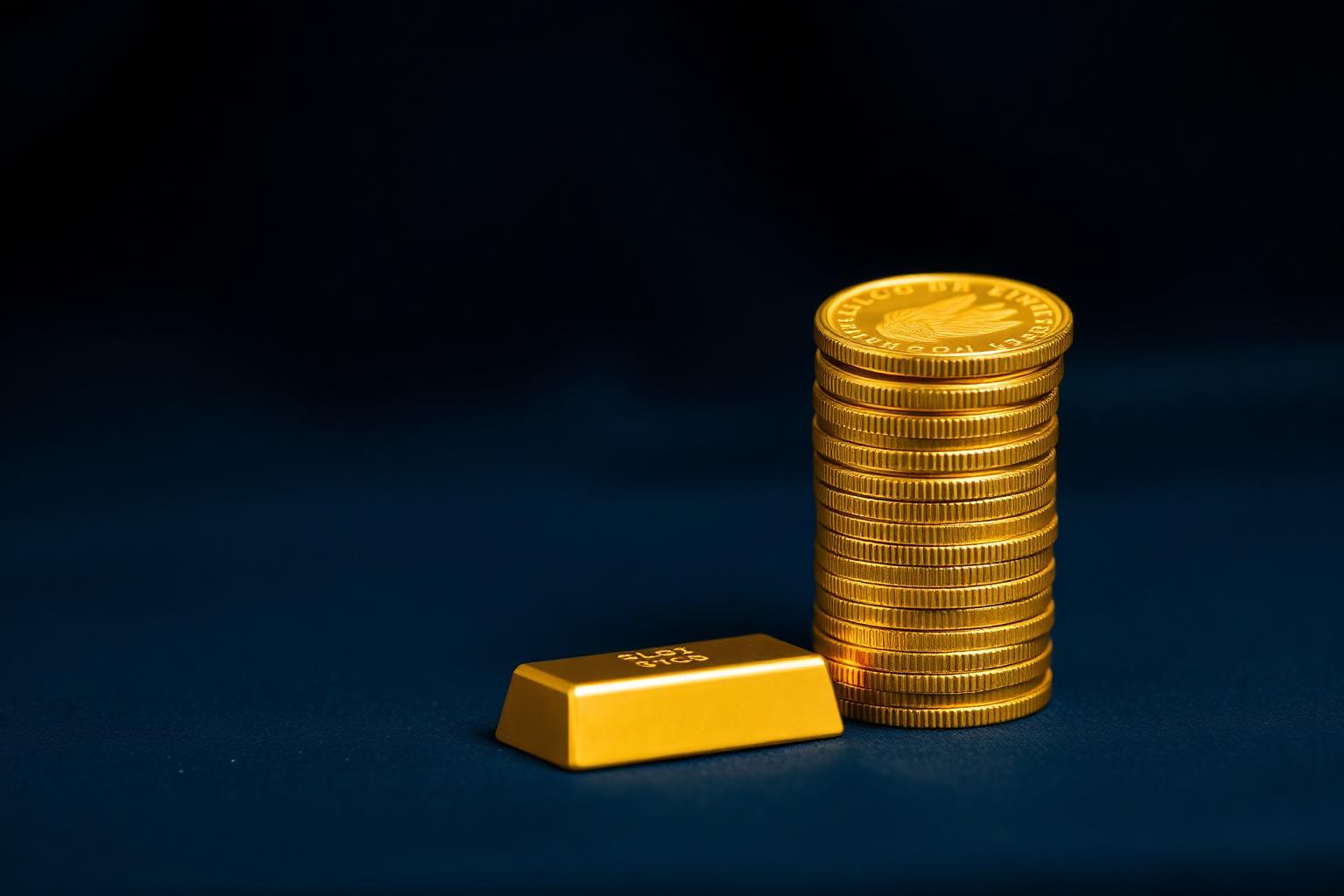
American Gold Eagle and Gold Buffalo bullion coins beside a 1 oz gold bar in an assay card on navy velvet
IRA-approved gold bullion for direct delivery or a self-directed Gold IRA — American Gold Eagles, Gold Buffaloes and serialised assay bars, priced off live spot with the premium disclosed.
Describe this illustration: American Gold Eagle and Gold Buffalo bullion coins beside a 1 oz gold bar in an assay card on navy velvet

Buy physical gold the way it should be done — named, IRA-approved bullion you can identify and verify, not a paper ticker. The American Gold Eagle, Gold Buffalo and serialised one-ounce bar shown here are exactly the products Capstone Metals stocks, prices against the live gold spot market with the premium stated up front, and ships fully insured to your door or places directly into a self-directed Gold IRA. Every purchase starts with the metal in front of you and the number in writing — the standard a precious metals buyer should expect and rarely gets.
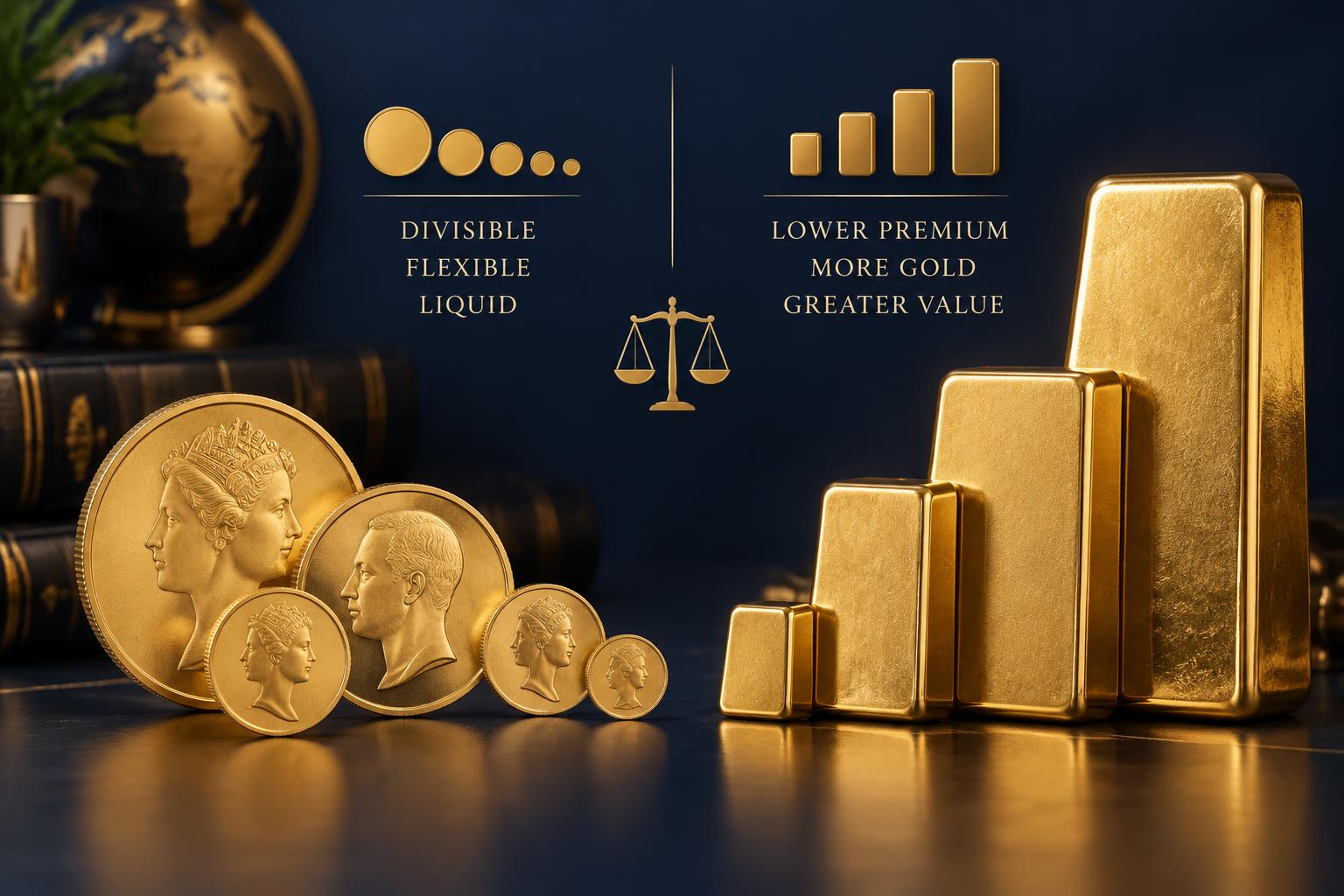
Comparison illustration of sovereign gold coins beside poured and minted bars with premium and divisibility labels
Coins cost more per ounce and can be sold one at a time. Bars cost less and must be sold whole.
Describe this illustration: Comparison illustration of sovereign gold coins beside poured and minted bars with premium and divisibility labels

Coins cost more per ounce and can be sold one at a time. Bars cost less and must be sold whole. This original Capstone Metals illustration illustrates comparison illustration of sovereign gold coins beside poured and minted bars with premium and divisibility labels. It is educational artwork, not a price forecast, performance record or recommendation.

Fractional sizes

Half, quarter and tenth-ounce coins cost more per ounce but let you sell in smaller increments — useful for gifting and for staged liquidation.

Rather just ask someone?

A specialist can answer this in two minutes. Monday – Friday, 7am – 4pm Pacific.

The short answer

A gold coin's value comes from three separable things: the metal it contains, the premium the market pays for that particular product, and — only for genuinely scarce coins — collector value. Confusing the third with the first is the most expensive mistake in this market.

Key facts

Each fact below is tied to a numbered source at the foot of this page. Follow the numbers and check us.

  1. 01

    Metal value, bullion premium and collectible value are three different things.2,3

    Melt value is the metal content at spot. A bullion coin trades at melt plus a modest, fairly predictable premium tied to fabrication and demand. A numismatic coin trades on rarity, condition and grade, which can be many multiples of melt and depends on a collector market rather than the gold price.

  2. 02

    The American Gold Eagle contains one troy ounce of fine gold in a 33.931-gram coin.2

    Federal law sets the fifty dollar coin at 32.7 mm diameter and 33.931 grams containing one troy ounce of fine gold. The gold content is a full ounce; the alloy makes the coin roughly 91.67% gold overall and considerably more durable than a pure-gold coin.

  3. 03

    Federal law specifies four Gold Eagle sizes, and this matters for IRA eligibility.1,2

    31 U.S.C. §5112(a)(7) through (a)(10) specify one-ounce, half-ounce, quarter-ounce and tenth-ounce gold coins. §408(m)(3)(A)(i) exempts coins described in exactly those four paragraphs from collectible treatment — which is why these coins are eligible despite being below 995 fine.

  4. 04

    Not every gold coin can go into an IRA, and purity alone does not decide it.1,3

    A coin qualifies either by being named through §408(m)(3)(A) or by being bullion meeting the contract-market fineness standard under §408(m)(3)(B). A .9999 fine foreign coin generally travels the bullion route; a graded, slabbed, collectible coin normally travels neither and remains a collectible under §408(m)(2)(D).

  5. 05

    Premium on bullion coins compresses; premium on collectibles is a separate market.3

    Buy a common bullion coin at an unusually wide premium and you generally give that back on resale, because the premium reflects temporary supply conditions. Collector premiums move with the collector market, which can be illiquid and can decline independently of the gold price.

  6. 06

    Standardised specifications are what make coins easy to authenticate.2

    Because the statute fixes diameter and weight, a genuine coin's dimensions, mass and the way it rings are all checkable. That is a practical advantage over unbranded bars, where content generally has to be taken on the assay certificate or verified by test.

  7. 07

    Grading turns a bullion coin into a different asset class.1

    Third-party grading and encapsulation prices a coin on condition. That price depends on the grading service's opinion and on collector demand for that grade — considerations entirely separate from the ounce of gold inside. Grading a common bullion coin rarely adds resale value proportional to its cost.

  8. 08

    Spot price and the price of a physical coin or bar are two different numbers, and the gap is not a markup hidden from you.3,4

    Spot is the price for large, wholesale, exchange-deliverable metal — the COMEX gold contract, for example, settles against bars assaying at least 995 fineness. A one-ounce coin has to be refined, minted, distributed, insured and inventoried before it reaches you, and it can be resold in single units. That fabrication and liquidity has a cost, quoted as a premium over spot.

The vocabulary

Melt value
The coin's metal content valued at spot, ignoring design, condition and rarity.
Bullion coin
A coin minted for investors, priced on metal content plus a modest premium.
Numismatic coin
A coin priced on rarity, condition and collector demand rather than metal content.
Semi-numismatic
A marketing term, not a defined category. Treat any coin sold this way as needing separate justification for its premium.
Proof
A specially struck finish sold at a premium to the bullion version of the same coin.
Grade
A third-party opinion of a coin's condition on a numeric scale, usually with encapsulation.
Gross weight
What the whole coin weighs, alloy included — distinct from its fine gold content.
Fine gold content
The actual weight of pure gold in the coin. This is what you own.

Bullion value against collectible value

The same coin can be sold to you on either basis. Knowing which one you are buying is the whole game.

Bullion coinCollectible / graded coin
Price driven byGold spot plus a modest premiumRarity, grade and collector demand
Typical premiumModest and fairly predictableLarge and highly variable
Tracks the gold priceCloselyLoosely, sometimes not at all
LiquidityHigh — any dealer bidsNarrower specialist market
IRA eligibilityCommonly eligible via §408(m)(3)Generally a collectible under §408(m)(2)(D)

How to evaluate a gold coin purchase

  • Establish the fine gold content, then the melt value at today's spot.
  • Express the asking price as a premium over melt, in dollars and percent.
  • Ask what the same dealer bids for that coin today.
  • If the premium is large, ask precisely what you are paying for beyond the gold.
  • If it is destined for an IRA, identify which statutory provision makes it eligible.
  • Prefer widely traded coins unless you are deliberately entering the collector market with your eyes open.

Risks and limitations

Anyone who only tells you the upside is selling, not explaining.

  • Collector premiums can evaporate.

    They depend on a specialist market's appetite, which can decline even as gold rises.

  • Grading costs are rarely recovered on common coins.

    Encapsulating an ordinary bullion coin usually costs more than it adds.

  • "Rare" and "limited" are sales language, not defined categories.

    Modern mint-issued products described as limited are often produced in large numbers.

  • An IRA cannot generally hold collectibles.

    Acquiring one inside an IRA is treated as a distribution equal to its cost under §408(m)(1).

Common misconceptions

Proof coins hold value better than bullion coins.

They carry higher premiums resting on collector demand. As a way to own gold, they cost more per ounce and are harder to resell at the price paid.

A graded coin is safer because it is authenticated.

Grading authenticates and opines on condition. It does not make the coin's premium durable, and it moves the coin into a market that prices condition rather than gold.

All .9999 coins are automatically IRA eligible.

Fineness satisfies the bullion route only, and the custodian still applies its own approved-product list. Being four-nines fine is necessary in that route, not sufficient overall.

Older coins must be worth more.

Age is not scarcity. Many old gold coins were minted in large numbers and trade close to melt.

Mistakes worth avoiding

  • Paying a numismatic premium while believing you bought bullion exposure.
  • Comparing coin prices without first converting them to a premium over melt.
  • Buying proof or commemorative product for an IRA and finding it ineligible.
  • Assuming a coin's face value has any bearing on its worth.
  • Selling a genuinely scarce coin into a bullion bid because nobody explained the difference.

Take this with you

Bullion or collectible: eight questions that settle it

  1. 1.What is the fine gold content of this coin, in troy ounces?
  2. 2.What is the melt value at the current spot price?
  3. 3.What is the asking price as a premium over melt, in dollars and percent?
  4. 4.What do you bid for this coin today?
  5. 5.Is any part of this price attributable to grade, rarity or condition?
  6. 6.How many of these were minted, and how many do you have in stock?
  7. 7.If for an IRA: which provision of §408(m)(3) applies?
  8. 8.Who else buys this coin, and at roughly what level?

What people ask next

Sources and references

Everything factual on this page traces to one of the following. Law and government publications come first, then exchange specifications and standards bodies.

  1. 1.
    26 U.S.C. § 408(m) — Investment in collectibles treated as distributions

    Legal Information Institute, Cornell Law School · Tier 1 Primary / government · checked 2026-09-02

    §408(m)(1) treats an IRA's acquisition of a collectible as a distribution equal to its cost. §408(m)(2) lists 'any metal or gem' and 'any stamp or coin' as collectibles. §408(m)(3) carves out specific U.S. coins and gold, silver, platinum or palladium bullion meeting a contract-market delivery fineness, and only where that bullion is in the physical possession of a trustee described in §408(a).

  2. 2.
    31 U.S.C. § 5112 — Denominations, specifications, and design of coins

    Legal Information Institute, Cornell Law School · Tier 1 Primary / government · checked 2026-09-02

    §5112(a)(7) specifies a fifty dollar gold coin 32.7 mm in diameter weighing 33.931 grams and containing one troy ounce of fine gold; (a)(8)–(a)(10) specify the half-ounce, quarter-ounce and tenth-ounce sizes. §5112(e) specifies a silver coin 40.6 mm in diameter weighing 31.103 grams containing .999 fine silver. §5112(k) authorises the platinum bullion coin.

  3. 3.
    Gold futures contract specifications (COMEX)

    CME Group · Tier 2 Industry / authoritative · checked 2026-09-02

    Under 'Grade and Quality': gold delivered under the COMEX gold futures contract must assay to a minimum of 995 fineness. This is the contract-market delivery standard that §408(m)(3)(B) points to for gold bullion.

  4. 4.
    Good Delivery

    London Bullion Market Association · Tier 2 Industry / authoritative · checked 2026-09-02

    The LBMA maintains the Good Delivery List of accredited gold and silver refiners and the physical specifications a bar must meet to be acceptable in the London market.

Who wrote and reviewed this

Written by
Travis Bugli
Chief Executive Officer and licensed agent, Capstone Metals
Reviewed by
Mark Bugli
Senior Advisory Partner, licensed since 1970
First published
2026-09-02
Last reviewed
2026-09-02
Change log (1)
  • 2026-09-02

    Added the melt / bullion premium / collectible value separation, the statutory basis for Gold Eagle eligibility at 22 karat, and an eight-question bullion-or-collectible test.

    Why: The bullion-versus-collectible distinction is where retail buyers lose the most money and the page did not explain it.

This page explains general rules and mechanics. It is not individualised tax, legal or investment advice, and Capstone Metals is a precious-metals dealer rather than a custodian, trustee or depository. Confirm eligibility for any specific product with your IRA custodian, and discuss suitability with your own advisers.

Would a short, no-pressure conversation help?

Leave your name and number. A Capstone specialist will answer your questions during business hours.

Most gold and silver firms can only talk to you about gold and silver. We have licensed advisors on staff, so the same conversation can cover your retirement accounts, your market holdings, insurance and estate structure alongside a completely private metals purchase — one fiduciary review of everything you own, not a sales call about one product.

What would you like help understanding? (optional)

By submitting your name and phone number you are asking us to follow up, and you agree that Capstone Metals may contact you by phone, text, or email to clarify what you are looking for and make sure you receive it. Message and data rates may apply. You can ask us to stop at any time by replying STOP or telling us on the phone, and we never sell or share your information. This is a request for information and a conversation — not a purchase, an application, or advice. SMS Opt-In Policy · Privacy Policy · Terms & Conditions · How pricing works · Disclosures · Due diligence & financial risks

Licensed and insuredFiduciary advisory since 1970Independent IRA custodiansPrices quoted, never card-charged

Want a number rather than a conversation first? Request current gold pricing — itemized spot reference and premium, with the research and its limits sent afterwards.

Common questions

Do coins need to be graded?
No. For bullion, grading adds cost without adding metal. Buy uncertified bullion coins in mint condition.
What is a gold bullion coin?
A coin minted for investors and priced on its metal content plus a modest premium, rather than on rarity or condition. Production tracks investor demand rather than being limited for collectors.
What is gold purity in a coin?
The proportion of the coin's mass that is gold, quoted as fineness. A Gold Eagle contains a full troy ounce of fine gold within a 33.931-gram coin, making the coin itself about 91.67% gold; many other sovereign coins are .9999 fine and weigh close to one ounce in total.
What does .9999 fine gold mean?
999.9 parts gold per 1,000 — 99.99% pure, often called four nines. It is purer and softer than a 22-karat alloyed coin, which is why such coins are usually handled more carefully.
How is a gold coin valued?
Start with fine gold content multiplied by spot, which is melt value. Add the market premium for that product. Only for genuinely scarce coins does a separate collector value apply on top, and that value moves with the collector market rather than gold.
What is the difference between bullion and collectible coins?
Bullion coins track gold closely at a modest premium and are liquid everywhere. Collectible coins are priced on rarity and grade, carry much larger premiums, trade in a narrower market, and are generally treated as collectibles for IRA purposes.
What affects gold coin premiums?
Coin size, the issuing mint's standing, current retail demand for that specific product, and available supply. Premiums on the same coin can widen materially in a busy market and narrow again afterwards.
How can buyers compare gold coins fairly?
Convert every quote into a premium over melt value per troy ounce of fine gold. That reduces different coins, sizes and finishes to one comparable number.
Can all gold coins be held in an IRA?
No. Eligibility runs through §408(m)(3): specified U.S. coins, or bullion meeting the contract-market fineness standard, in either case held by a qualifying trustee. Graded and collectible coins generally remain collectibles under §408(m)(2)(D).
Why are American Gold Eagles IRA eligible at 22 karat?
Because §408(m)(3)(A)(i) exempts coins described in paragraphs (7) through (10) of 31 U.S.C. §5112(a) by name. Those are the four Gold Eagle sizes. They qualify as named coins, so the bullion fineness test does not apply to them.
How should gold coins be stored?
In their mint tubes or capsules, away from handling, either in a depository or securely at home. Gold does not tarnish, but 24-karat coins mark easily, and visible handling marks reduce what a buyer will pay.
How can buyers evaluate a gold coin purchase?
Establish fine gold content, compute melt value, express the price as a premium, ask for the dealer's bid on the same coin, and require a clear explanation of any premium beyond ordinary bullion levels.
Should I buy graded coins for a retirement account?
Generally no. Graded and collectible coins are usually collectibles for §408(m) purposes, and acquiring a collectible in an IRA is treated as a distribution equal to its cost. Speak to your custodian before assuming any graded product qualifies.

Browse gold coin pricing

Live premiums on every sovereign coin we stock.

Licensed and insuredFiduciary advisory since 1970Independent IRA custodiansPrices quoted, never card-charged
Call (800) 200-9553 Text Email