

Capstone Metals — gold and silver IRA dealer
Speak with a specialist: (800) 200-9553Monday – Friday, 7am – 4pm Pacific

Cornerstone research

Gold through time: why gold has remained part of the world's monetary and economic system

This is the long answer to a short question: why is a soft yellow metal still on the balance sheets of the world's central banks in 2026, decades after the last currency stopped being convertible into it? The honest answer is not mystical, and it is not a sales pitch. It is documented — in Federal Reserve histories, IMF papers, central-bank reserve templates and market records — and the documents disagree with each other in useful ways. Everything below is dated, attributed and separated into what is recorded, what is argued, and what nobody can establish.

Monday – Friday, 7am – 4pm Pacific

  • Licensed and insured since 2014
  • Fiduciary advisory — licensed since 1970
  • Preferred Trust & GoldStar custodians
  • No card payments, no pressure, no commissions-first pitch

Continuous records

Centuries, not millennia

Convertibility ended

1971 — and never returned

Still a reserve asset

Yes — publicly reported

Guaranteed to rise

No, and nobody can say

The short answer

Gold persisted in monetary use because of a combination of physical facts and institutional habits, not magic. It is chemically durable and does not corrode, it is scarce enough to be worth transporting and divisible enough to be worth counting, and — the property that still matters in 2026 — it is nobody's liability. A government bond is a promise from a government; a reserve deposit is a promise from another central bank; gold in a vault is not a promise at all. The Federal Reserve's own historical account describes the gold standard as a nominal anchor of a past era, and an IMF note published in July 2026 states the modern version of the same point for reserve managers: gold carries no credit risk. That same note is equally direct that gold is volatile and that its hedging and diversification benefits are conditional. Both sentences belong on this page.

  • HISTORICAL RECORD. Gold was used in coinage and monetary systems across many societies, in different forms and at different times
  • HISTORICAL RECORD. Continuous documentary records of gold prices and monetary use run for centuries — the industry's own long-run series begins around 1600
  • FACT. No major currency has been convertible into gold since 1971
  • DATA. Gold nonetheless remains a reported reserve asset of central banks today
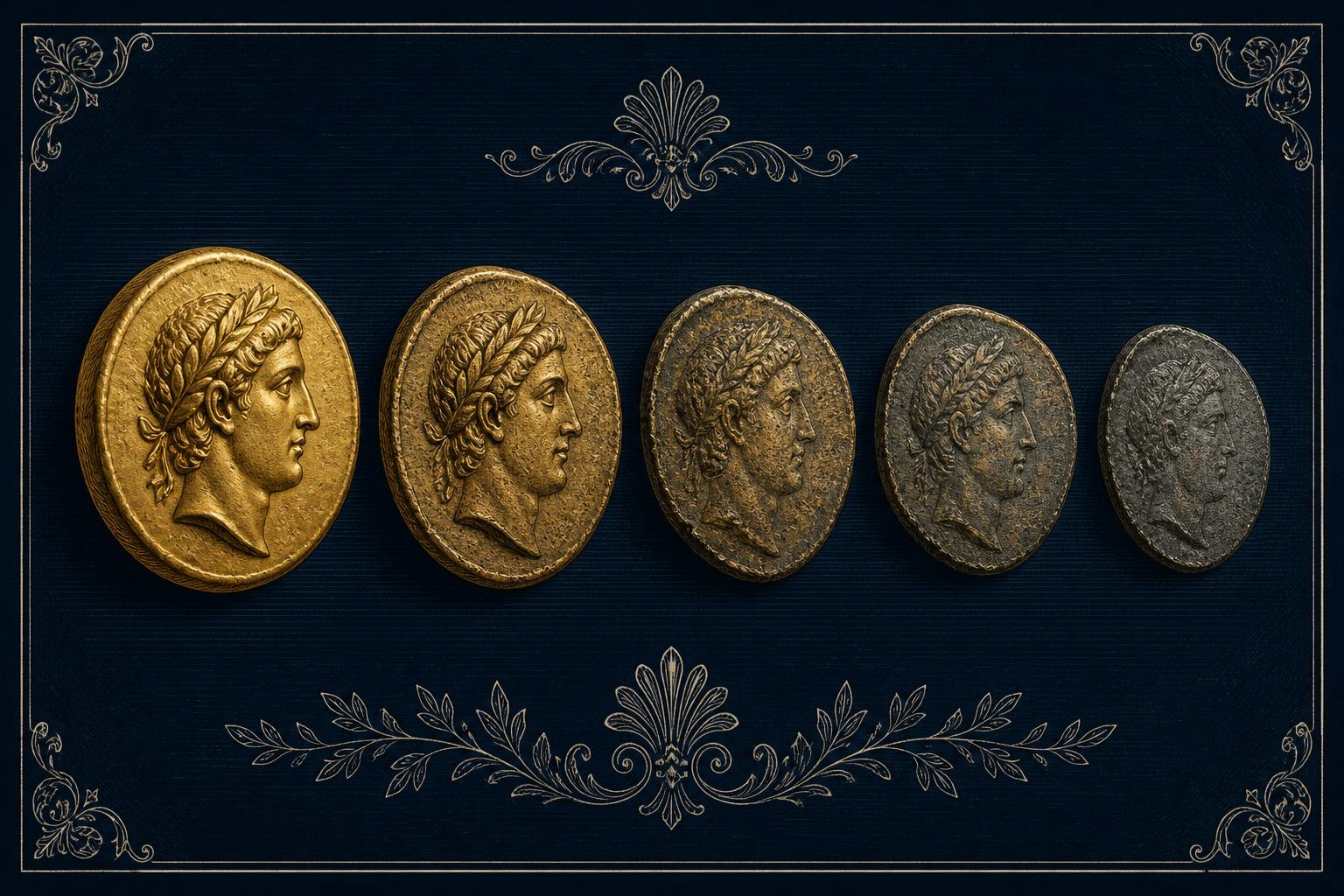
Five ancient profile-portrait coins in a row on navy, the first bright and thick gold and each successive one thinner, duller and greyer until the last is base metal
Reducing the metal in the coin while keeping the face on it is the oldest recorded way to spend money a treasury does not have.
Describe this illustration: Five ancient profile-portrait coins in a row on navy, the first bright and thick gold and each successive one thinner, duller and greyer until the last is base metal

An original Capstone Metals illustration of currency debasement, a pattern documented across successive empires by surviving coinage and by the historical record rather than by any modern argument. Rulers who needed to spend more than they collected repeatedly cut the precious metal content while keeping the coin's stated value, and the purchasing power of the coin fell accordingly. The pattern is real and repeated. It is not a forecast about any particular currency or any particular year, and we do not present it as one.

From coinage to a global standard

HISTORICAL RECORD. Gold entered monetary use as coin — struck, weighed and stamped by issuing authorities — long before there were central banks to hold it. What is often described loosely as one 5,000-year system was in fact many different arrangements: bimetallic systems, silver standards, coin debasements, and long periods where gold played little monetary role in a given region at all. The classical gold standard, the arrangement most people mean by the phrase, is far more recent: it took hold among major economies in the later nineteenth century and did not survive the First World War intact. Being precise about this matters, because the exaggerated version — an unbroken golden age of sound money — is used to sell things.

Bretton Woods, 1971, and what replaced it

FACT. Under the Bretton Woods arrangement agreed in 1944, other currencies were pegged to the US dollar and the dollar was convertible into gold at $35 an ounce for foreign official holders. FACT. In August 1971 the United States suspended that convertibility, and the system of fixed parities that depended on it broke down over the following years. The Federal Reserve documents both events in its own histories, including a 2026 staff note tracing how gold appeared on its balance sheet through the period. An IMF working paper examines why the system came under such strain. What replaced it is the world we live in: currencies whose value rests on the policies and credibility of the institutions that issue them, with gold held alongside as a reserve asset rather than as the anchor.

  • 1944 — Bretton Woods pegs currencies to the dollar; the dollar is convertible into gold for foreign official holders
  • August 1971 — the United States suspends convertibility
  • 1970s onward — floating exchange rates; gold trades freely and is no longer a monetary anchor
  • Today — gold is a reserve asset among others, publicly reported by central banks

Who actually holds gold — public evidence, not speculation

This is the section most gold marketing turns into a conspiracy, and it does not need to be one. The real picture is publicly documented and more interesting than the invented version. DATA. Central banks report their reserve assets, and those reports include gold: the European Central Bank's reserve template is one example anyone can open. DATA. The Bank of England publicly describes holding around 400,000 gold bars in its vaults and providing safe custody for the UK's gold and for other central banks, which is how official gold connects to the London market. DATA. The IMF publishes a factsheet on its own gold holdings and the rules constraining what it may do with them. EXPERT ANALYSIS. The LBMA's reference material describes how official institutions actually hold and transact the metal, and a Banque de France account describes one central bank's own reserve management in detail. None of this is hidden. It is filed, published and searchable.

  • DOCUMENTED HOLDINGS — central banks and the IMF publish what they hold
  • DOCUMENTED RATIONALE — reserve managers state their reasons in their own publications
  • INSTITUTIONAL ANALYSIS — the IMF, the Fed and market bodies analyse those reasons
  • UNSUBSTANTIATED — claims that named individuals secretly hoard gold, or that holdings are concealed from the public, do not follow from any of the above

Why reserve managers say they hold it

EXPERT ANALYSIS. The reasons given in official and institutional publications are consistent and unromantic: gold has no credit risk because it is nobody's obligation; it diversifies a reserve portfolio otherwise concentrated in a handful of currencies and sovereign bonds; the market is deep enough to transact in size; it has been useful in crises when other assets were impaired; and there are historical and strategic considerations specific to each country. SURVEY EVIDENCE. The World Gold Council's 2026 survey of reserve managers reports that 93% of respondents held gold and 45% expected to increase holdings over the following twelve months — but that is self-reported opinion from a subset of institutions, gathered by an industry body, and should be read as such rather than as a measurement of what will happen.

What this means for a private investor — and what it does not

A central bank and a household are not doing the same thing. A reserve manager holds gold to make a national balance sheet resilient over decades, with no need to sell at a particular time, and pays nothing for storage because it owns the vault. A household faces premiums, spreads, storage or depository fees, and a real chance of needing the money at an inconvenient moment. So the official-sector case is context, not a personal recommendation. What the evidence supports is narrow and worth stating plainly: gold is an asset with no issuer, a long history of monetary use, a deep market, and a return that depends entirely on price because it produces no income.

  • It behaves differently from stocks and bonds — that is the diversification argument, and it is a long-horizon one
  • It pays nothing, and storage and insurance cost something every year
  • It has fallen for years at a stretch, including after its 1980 and 2011 peaks
  • Concentrating a large share of savings in it introduces a different risk, not less risk

What the evidence does NOT prove

It does not prove that gold will rise, that it protects against every kind of loss, or that any particular percentage of a portfolio belongs in it. Central banks buying gold is evidence about central banks, not a signal about your retirement account. The IMF's 2026 note is explicit that gold's hedging and safe-haven behaviour is conditional — it has not always worked, and it has fallen during liquidity events when everything was being sold. And none of the institutions cited on this page has any relationship with Capstone Metals or comments on any dealer or gold IRA. Citing a document creates no endorsement, and no sentence on this site may imply otherwise.

What serious institutions disagree about

The disagreement is real and is more informative than any consensus would be. The World Gold Council argues gold deserves a standing strategic allocation. Morningstar accepts a diversification role while recommending limited rather than open-ended exposure and stressing volatility and the absence of income. Fidelity's education says short-term movements are unpredictable. Bridgewater treats gold's repricing against fiat currencies as a question about the monetary regime. Goldman Sachs, J.P. Morgan and UBS publish price forecasts that get revised in both directions. The IMF, writing for reserve managers rather than for investors, says gold is prominent and credit-risk-free but conditional in its benefits. Read them against each other; that is what they are for.

Rather just ask someone?

A specialist can answer this in two minutes. Monday – Friday, 7am – 4pm Pacific.

Would a short, no-pressure conversation help?

Leave your name and number. A Capstone specialist will answer your questions during business hours.

Most gold and silver firms can only talk to you about gold and silver. We have licensed advisors on staff, so the same conversation can cover your retirement accounts, your market holdings, insurance and estate structure alongside a completely private metals purchase — one fiduciary review of everything you own, not a sales call about one product.

What would you like help understanding? (optional)

By submitting your name and phone number you are asking us to follow up, and you agree that Capstone Metals may contact you by phone, text, or email to clarify what you are looking for and make sure you receive it. Message and data rates may apply. You can ask us to stop at any time by replying STOP or telling us on the phone, and we never sell or share your information. This is a request for information and a conversation — not a purchase, an application, or advice. SMS Opt-In Policy · Privacy Policy · Terms & Conditions · How pricing works · Disclosures · Due diligence & financial risks

Licensed and insuredFiduciary advisory since 1970Independent IRA custodiansPrices quoted, never card-charged

Want a number rather than a conversation first? Request current gold pricing — itemized spot reference and premium, with the research and its limits sent afterwards.

Common questions

Why is gold valuable at all?
Physically, because it is durable, scarce, divisible and easy to verify — the US Geological Survey documents the properties and the long-term store-of-value use. Financially, because it is nobody's liability, which is why the IMF notes it carries no credit risk. Neither reason guarantees a price.
Has gold really been money for 5,000 years?
Gold has been used monetarily by many societies over thousands of years, but not as one continuous unchanged system — and continuous documentary records run for centuries, not millennia. The industry's own long-run series begins around 1600. The exaggerated version of this claim is a marketing line, not history.
The documented timeline
What happened in 1971?
The United States suspended the convertibility of dollars into gold for foreign official holders, which ended the Bretton Woods arrangement of fixed parities. Currencies have floated since. The Federal Reserve documents this in its own histories.
Bretton Woods and 1971
Do central banks still hold gold, and why?
Yes, and they publish it. The stated reasons are diversification, no credit risk, market depth, crisis utility and country-specific strategic considerations — written in their own publications and analysed by the IMF.
The reserve-management reasons
Is any of this evidence that I should buy gold?
No. It is evidence about what institutions do and why, which is context for a decision rather than the decision. Whether gold suits your situation depends on your income, debts, time horizon and what you already own — and for some people the answer is no.
Does gold protect against everything?
No. The IMF's 2026 note states that gold's hedging and diversification benefits are conditional, and gold has fallen sharply in liquidity events. It is a diversifier with a long record, not insurance.
The risks, in full

Understand how gold has actually been used

Read the pages below in whatever order matches your question. If you would rather talk it through, leave your name and a phone number — a specialist, or a licensed financial advisor when the question spans retirement accounts, market holdings or insurance, will call and go through it plainly. No obligation, and no card at any point.

Licensed and insuredFiduciary advisory since 1970Independent IRA custodiansPrices quoted, never card-charged
Call (800) 200-9553 Text Email