



Capstone Metals — gold and silver IRA dealer
Speak with a specialist: (800) 200-9553Monday – Friday, 7am – 4pm Pacific

Storage & custody

Where your metal actually sits

Storage is where a lot of precious metals buyers get quietly shortchanged. Who holds the metal, whether your specific bars are set aside, and what the insurance actually covers all matter more than the brochure suggests.

Monday – Friday, 7am – 4pm Pacific

  • Licensed and insured since 2014
  • Fiduciary advisory — licensed since 1970
  • Preferred Trust & GoldStar custodians
  • No card payments, no pressure, no commissions-first pitch
Precious metals depository vault door
From the Capstone Metals Wealth Protection Guide, 2026 edition.

IRA metal

Depository only

Segregated

Your exact bars

Insurance

All-risk, full value

Audits

Independent, annual

IRA metal must be held by an approved depository

Metals inside a self-directed IRA are titled to the custodian for your benefit and stored at an IRS-approved depository. That is not a preference, it is the rule that keeps the account intact.

  • Vaults are Class 3 rated, alarmed and under continuous monitoring
  • Holdings are insured at full replacement value under an all-risk policy
  • Independent audits confirm the metal on hand matches the account records

Corridor of steel shelving stacked with gold and silver bullion bars inside a secure depository vault
Where IRA and vaulted metal actually lives: a rated depository with segregated shelving and all-risk insurance — not a home safe.
Describe this illustration: Corridor of steel shelving stacked with gold and silver bullion bars inside a secure depository vault

Where your metal lives is the first question any storage or IRA page must answer. IRA and vaulted precious metals belong in a rated depository like this one — segregated, audited and insured all-risk — not in a home safe that voids both the insurance and the IRA's tax status. Capstone Metals places gold and silver in your name at accredited depositories with fully insured, segregated storage available on request, so the asset that protects your savings is itself protected to the standard the metal demands. Storage is never an afterthought here; it is part of the purchase.
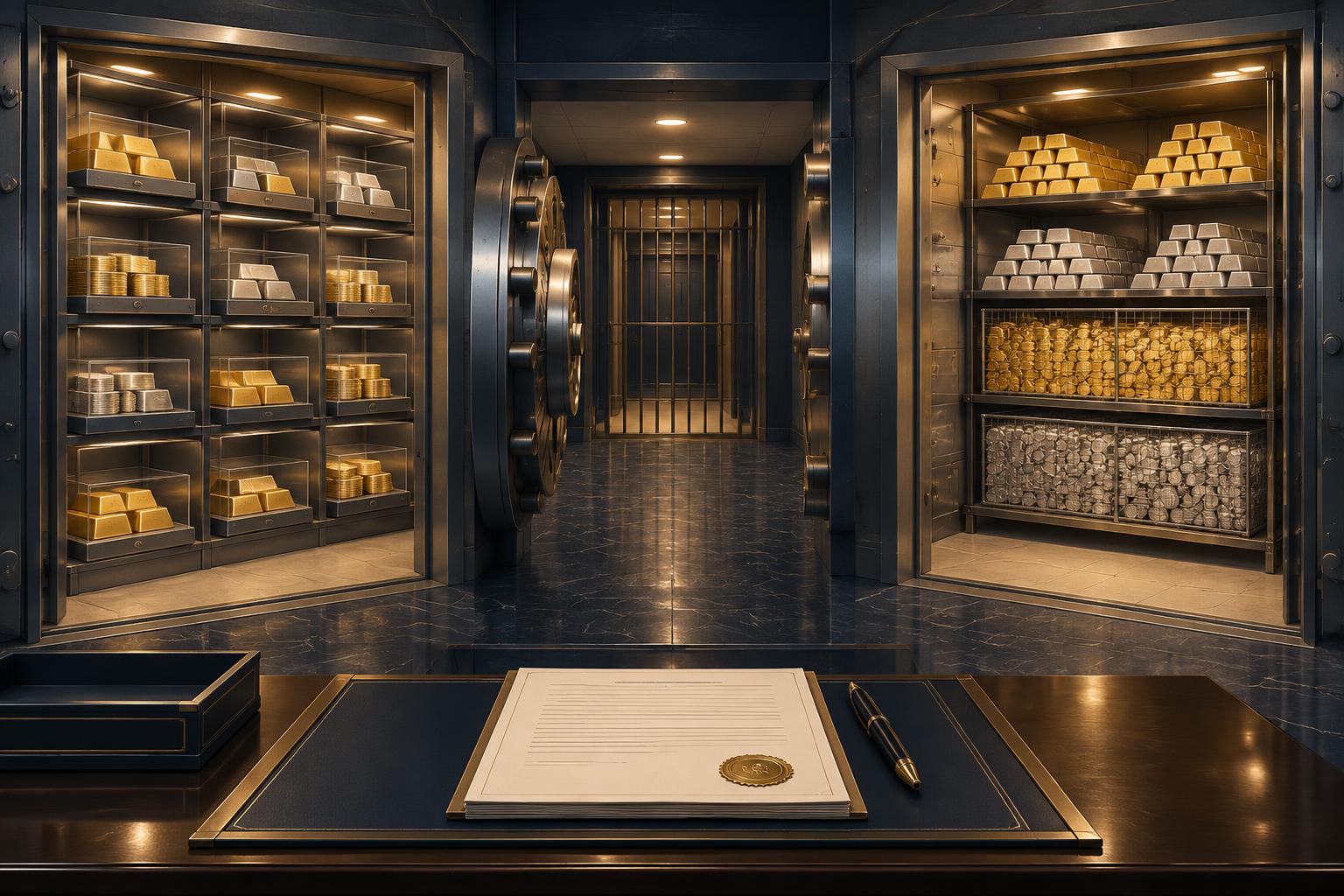
Diagram of a depository showing segregated and commingled storage arrangements under a custodian
Where IRA metal is required to live, and the difference between segregated and commingled storage.
Describe this illustration: Diagram of a depository showing segregated and commingled storage arrangements under a custodian

Where IRA metal is required to live, and the difference between segregated and commingled storage. This original Capstone Metals diagram illustrates diagram of a depository showing segregated and commingled storage arrangements under a custodian. It is educational artwork, not a price forecast, performance record or recommendation.

Segregated versus commingled

Segregated storage sets aside your exact bars and coins under your account number, so what you deposit is what you withdraw. Commingled storage pools like-for-like product and returns equivalent metal. Commingled is cheaper; segregated is cleaner, particularly for bars with serial numbers you want to keep.

Home storage and the 'home storage IRA' pitch

Metal you buy privately can be kept anywhere you like — a home safe, a bank box, or a private vault. Metal inside an IRA cannot. Any pitch that promises an LLC structure letting you keep IRA bullion in your own safe is inviting the IRS to treat the whole account as distributed.

Getting metal out

Distributions and private holdings ship fully insured, discreetly packaged, signature required. You can also take an in-kind distribution from an IRA and have the exact coins delivered rather than sold.

Rather just ask someone?

A specialist can answer this in two minutes. Monday – Friday, 7am – 4pm Pacific.

Would a short, no-pressure conversation help?

Leave your name and number. A Capstone specialist will answer your questions during business hours.

Most gold and silver firms can only talk to you about gold and silver. We have licensed advisors on staff, so the same conversation can cover your retirement accounts, your market holdings, insurance and estate structure alongside a completely private metals purchase — one fiduciary review of everything you own, not a sales call about one product.

What would you like help understanding? (optional)

By submitting your name and phone number you are asking us to follow up, and you agree that Capstone Metals may contact you by phone, text, or email to clarify what you are looking for and make sure you receive it. Message and data rates may apply. You can ask us to stop at any time by replying STOP or telling us on the phone, and we never sell or share your information. This is a request for information and a conversation — not a purchase, an application, or advice. SMS Opt-In Policy · Privacy Policy · Terms & Conditions · How pricing works · Disclosures · Due diligence & financial risks

Licensed and insuredFiduciary advisory since 1970Independent IRA custodiansPrices quoted, never card-charged

Common questions

Can I visit the depository and see my metal?
Yes. Approved depositories accommodate scheduled account-holder viewings with identification and advance notice.
What does storage cost?
Depository storage and insurance is typically billed annually as a flat fee or a small percentage of holdings, depending on whether you choose commingled or segregated. We show the exact schedule before you fund.
Is my metal insured against theft and disaster?
Depository holdings are covered by an all-risk policy at full replacement value. Metal stored at home is only covered if your own policy specifically schedules bullion, which most do not.
Can I move my metal to a different depository later?
Yes. Your custodian can transfer holdings between approved depositories without selling the metal.

Ask exactly where your metal would sit

We will walk you through the depository, the insurance and the fee line by line.

Licensed and insuredFiduciary advisory since 1970Independent IRA custodiansPrices quoted, never card-charged

Vaulting & insurance

Military-grade vaults, insured at Lloyd's of London

The metal we place for clients does not sit in a back room. It sits in UL-rated depository vaults with armed response, redundant monitoring and independent audits — and it is insured under an all-risk specie policy underwritten by syndicates at Lloyd's of London, the market that has been writing risk since a coffee house by the Thames in the 1680s.

All-risk, including natural catastrophe

Specie is a defined class of business at Lloyd's, written for bullion, coin and other high-value property. Cover is placed on an all-risk basis, which typically includes fire, flood, earthquake, windstorm, theft, armed robbery, employee dishonesty, transit loss and mysterious disappearance. Natural catastrophe — the 'act of God' most ordinary policies argue about — is normally a covered peril rather than a carve-out. The named perils, sublimits and exclusions live in the depository's policy, and you get to read them.

Insured to replacement value, not a statutory cap

Depository specie programs are written to the replacement value of the metal held, not to a government coverage limit. That is a structurally different thing from a bank deposit, which is insured to at least $250,000 per depositor, per insured bank, per ownership category.

Allocated in your name, audited

In segregated storage your specific bars and coins are recorded to you by serial or lot. Depository holdings are identified as customer property under the Uniform Commercial Code — not assets of the depository — and independent auditors verify holdings. Ask us for the audit letter and the certificate of insurance; we will send both.

A vault is not a bank

Money in a bank is a loan you made to that bank: you hold a claim, and FDIC insurance responds if the bank fails. Metal in an allocated, insured vault is property you already own; the depository is a custodian, not a borrower. For IRA metal, that custody is not optional — the IRS requires a qualified trustee or custodian.

Underwriters you can look up

Lloyd's is a marketplace of more than a hundred syndicates rather than a single carrier, and its financial strength is rated independently — A+ (Superior) by AM Best and AA- by S&P Global Ratings. You do not have to take our word for any of it; the rating agency publishes its own disclosure.

Nearly 350 years of paying claims

Lloyd's traces to Edward Lloyd's coffee house in the 1680s and has underwritten war, earthquake, hurricane and maritime catastrophe ever since. Longevity is not a guarantee, but a market that has settled claims through three centuries of crises is a different counterparty from one founded last decade.

Cash in a bank vs. metal in an insured vault

Comparison of holding cash in a bank versus holding metal in an allocated depository vault insured under an all-risk specie policy
 Cash in a bankMetal in an insured vault
What you actually holdA claim on the bankProperty titled to you
Loss protectionFDIC to at least $250,000 per depositor, per bankAll-risk specie cover to replacement value, subject to policy terms
What triggers coverageFailure of the insured bankPhysical loss or damage to the metal, per the policy's perils
Counterparty riskBank solvency and the creditor waterfallCustodian is a bailee, not a debtor; holdings are customer property
Purchasing powerErodes with currency issuanceTracks the metal — which can fall as well as rise

One caveat we would rather you hear from us: no policy insures you against the price of gold or silver falling. Insurance protects the metal, not its market value. And Lloyd's is not the only market that will cover catastrophe risk — it is simply the oldest, one of the most independently scrutinised, and the one under which specie cover is most commonly placed.

Call (800) 200-9553 Text Email