


Capstone Metals — gold and silver IRA dealer
Speak with a specialist: (800) 200-9553Monday – Friday, 7am – 4pm Pacific

Comparison

Physical gold vs a gold ETF: what you actually own

Both give you exposure to the gold price. Only one of them removes a counterparty, and only one of them can be bought in seconds from a phone. That is the real trade, and it is not the trade most comparisons describe — so here it is in plain terms, including the cases where the fund is the more sensible choice.

Monday – Friday, 7am – 4pm Pacific

  • Licensed and insured since 2014
  • Fiduciary advisory — licensed since 1970
  • Preferred Trust & GoldStar custodians
  • No card payments, no pressure, no commissions-first pitch

ETF

A security, held in a brokerage

Physical

Metal, held by you or a depository

ETF cost

Annual expense ratio

Physical cost

Premium, spread, storage

What each one is

FACT. A gold exchange-traded fund is a security whose value tracks gold, held in a brokerage account and traded like a share. Physical gold is metal — a coin or bar you can hold, or that an approved depository holds under a custodian inside an IRA. The exposure looks similar on a chart; the ownership is not the same thing, and the difference only shows up in the conditions people buy gold to prepare for.

Left half shows five linked institutional boxes each pairing a building with a document; right half shows a single gold coin resting in an open hand, connected to nothing
A fund gives you the gold price through a chain of institutions. A coin gives you the metal. Same exposure, different number of parties standing in between.
Describe this illustration: Left half shows five linked institutional boxes each pairing a building with a document; right half shows a single gold coin resting in an open hand, connected to nothing

An original Capstone Metals illustration of the real trade between an exchange-traded gold fund and physical metal. The fund route involves a sponsor, a trustee, a custodian, an exchange and your brokerage, each of which must function for your position to behave as expected — and in exchange the fund is cheap, instant and easy to sell in size. Direct metal removes every one of those parties and replaces them with your own storage, insurance and resale decisions. Neither is automatically right; a short holding period usually favours the fund, and wanting the asset outside the financial system favours the coin.

Diagram of a depository showing segregated and commingled storage arrangements under a custodian
Where IRA metal is required to live, and the difference between segregated and commingled storage.
Describe this illustration: Diagram of a depository showing segregated and commingled storage arrangements under a custodian

Where IRA metal is required to live, and the difference between segregated and commingled storage. This original Capstone Metals diagram illustrates diagram of a depository showing segregated and commingled storage arrangements under a custodian. It is educational artwork, not a price forecast, performance record or recommendation.

The honest case for the ETF

It is cheap, it is instant, and it is easy to hold in an ordinary IRA or brokerage account alongside everything else. There is no storage to arrange, no insurance to buy, no shipping, and selling takes seconds at a quoted market price. EXPERT ANALYSIS. Fidelity's educational material sets out the several routes to precious-metals exposure without declaring one universally correct, and for a small tactical position a fund is often the practical answer.

  • Low annual expense ratio, no storage arrangements
  • Instant liquidity at a quoted price during market hours
  • Fits inside an existing brokerage or ordinary IRA
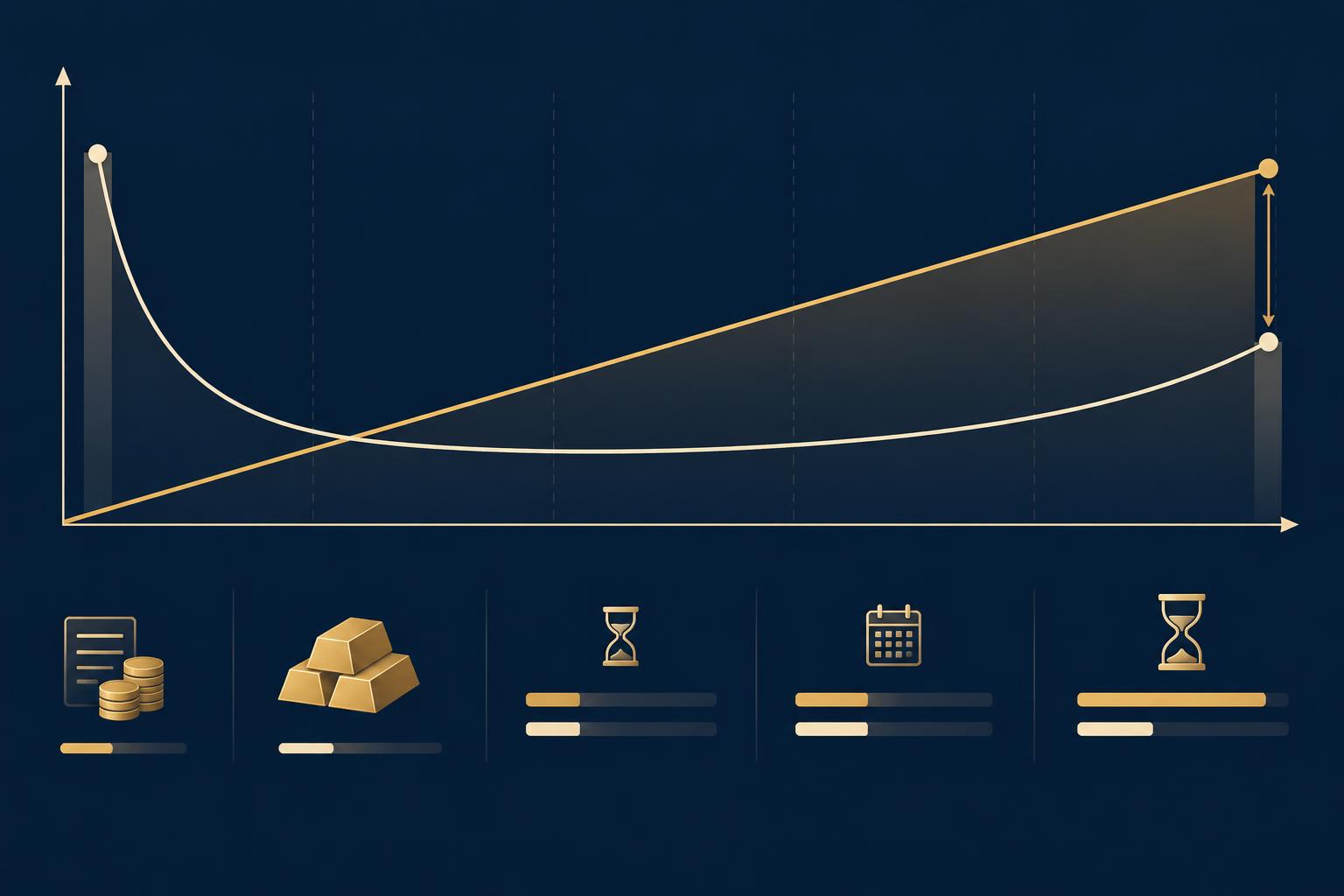
Chart comparing the cumulative cost of an annual expense ratio against a one-off premium and exit spread across holding periods
Over short periods the fund is usually cheaper. Over long ones the arithmetic narrows.
Describe this illustration: Chart comparing the cumulative cost of an annual expense ratio against a one-off premium and exit spread across holding periods

Over short periods the fund is usually cheaper. Over long ones the arithmetic narrows. This original Capstone Metals chart illustrates chart comparing the cumulative cost of an annual expense ratio against a one-off premium and exit spread across holding periods. It is educational artwork, not a price forecast, performance record or recommendation.

The honest case for physical

The reason most people give for wanting gold — that it is not anyone's promise — is only fully true when you hold the metal. A fund involves a sponsor, a trustee, a custodian, an exchange and a brokerage; each is a functioning institution and each is also a link in a chain. Physical metal outside that chain is the only version that keeps working if the chain does not, and it cannot be traded away in a panic with a tap.

  • No sponsor, trustee, exchange or brokerage in the way
  • Nothing to sell impulsively during a bad week
  • Deliverable and portable, in your name
Four-panel diagram of gold exposure routes: exchange-traded funds, futures, mining equities and physical metal
Four routes, four different risks. Only one removes the counterparty.
Describe this illustration: Four-panel diagram of gold exposure routes: exchange-traded funds, futures, mining equities and physical metal

Four routes, four different risks. Only one removes the counterparty. This original Capstone Metals diagram illustrates four-panel diagram of gold exposure routes: exchange-traded funds, futures, mining equities and physical metal. It is educational artwork, not a price forecast, performance record or recommendation.

Costs, compared properly

A fund charges an annual expense ratio, quietly, forever. Physical charges most of its cost up front — the premium over spot — plus a spread on exit and storage or depository fees while held. Over a short holding period the fund is usually cheaper; over a long one the arithmetic narrows and depends on premiums and fees. We will run those numbers honestly with you, including when the fund wins.

Inside a retirement account

FACT. Ordinary IRAs and most employer plans can hold gold funds directly. IRS-eligible bullion requires a self-directed IRA with an approved custodian and an approved depository, and IRA metal cannot be stored at home. Some households hold both: a fund for liquidity and metal for the counterparty-free portion.

What the research does NOT say

No source cited here declares one route correct for every investor, and neither do we. Nothing here is a recommendation of any specific fund, sponsor or product, and no organisation cited endorses Capstone Metals or physical metal over securities.

Rather just ask someone?

A specialist can answer this in two minutes. Monday – Friday, 7am – 4pm Pacific.

The short answer

A gold ETF is a security that tracks the gold price through a sponsor, trustee and brokerage; physical gold is metal with no counterparty. The fund is cheaper and instant, the metal is the only version that keeps the property most buyers say they want.

Key facts

Each fact below is tied to a numbered source at the foot of this page. Follow the numbers and check us.

  1. 01

    The Bank of England holds official gold in custody for the United Kingdom and for other central banks, supporting access to the London market.1

    Custody at a central bank is what makes large official holdings usable rather than merely owned. It is also a published arrangement, described by the Bank itself — no part of it is secret.

  2. 02

    Government and central-bank gold ownership is published, not hidden.2,6

    The LBMA's guide to central bank and governmental ownership, the IMF's own gold factsheet and individual reserve statements all describe holdings openly. Anyone claiming secret hoards is not working from public evidence.

  3. 03

    There are several distinct routes to precious-metals exposure, and broker education does not declare one universally correct.1,2,5,6

    Fidelity's material sets out funds, futures, mining equities and physical metal side by side, with volatility stated for each.

  4. 04

    Gold pays no interest and no dividend.5,7

    The entire return depends on the price when it is sold, so a long flat period has a genuine opportunity cost on top of storage or depository fees.

  5. 05

    IRS-eligible bullion inside a retirement account requires an approved custodian and depository.3

    A gold fund can sit in an ordinary IRA or brokerage account; physical IRA metal needs a self-directed IRA and cannot be held at home.

  6. 06

    Independent research supports gold as a diversifier while stating its limitations in the same breath.7

    Morningstar sets out its behaviour during equity stress alongside the long holding periods involved, its volatility, and the absence of income.

The vocabulary

Premium over spot
The amount a retail buyer pays above the wholesale metal value, covering minting, distribution and the dealer's margin. It should always be quoted in writing.
Bid-ask spread
The gap between the price at which a dealer sells and the price at which it buys back. It is a real cost paid on the round trip, whatever the metal price does.
Primary source
The original document — a statute, an official statistic, a central bank publication — rather than an article describing it. Every claim on this site is meant to trace back to one.
Exchange-traded fund
A pooled security traded on an exchange. Holding one means owning shares in a structure, not the underlying metal itself.
Expense ratio
The fund's annual charge, deducted continuously from the value of the holding.

Risks and limitations

Anyone who only tells you the upside is selling, not explaining.

  • Structural dependence in a fund

    A fund relies on a sponsor, trustee, custodian, exchange and brokerage. Each functions normally, and each is a link in a chain.

  • Up-front cost in physical

    The premium over spot and the buy/sell spread are paid regardless of holding period.

  • Storage and security in physical

    Held privately, storage, insurance and security become the owner's responsibility.

Common misconceptions

Central banks are buying, so the price must rise.

Official demand is one input among many, and it is already known to the market. Reserve managers buy for reserve-management reasons on multi-decade horizons, which says nothing reliable about the next year's price.

A retail ETF holder can request delivery of the metal.

Generally not. Where delivery exists it is typically limited to large authorised participants in substantial quantities. Assume no unless the fund documents say otherwise.

These institutions recommend gold IRAs, or recommend Capstone.

None of them has any relationship with Capstone Metals and none comments on any dealer. Citing a public document is not an endorsement, and no page here may imply it is.

Mistakes worth avoiding

  • Comparing an annual expense ratio against a one-off premium without fixing a holding period
  • Assuming a fund and a coin carry the same risk because they track the same price
  • Buying physical for a small, short-term tactical position where a fund is simpler

What people ask next

Sources and references

Everything factual on this page traces to one of the following. Law and government publications come first, then exchange specifications and standards bodies.

  1. 1.
    Gold (Bank of England)

    Bank of England · Tier 1 Primary / government · Reported data · checked 2026-09-15

    The Bank of England's public page on its gold vaults, describing the custody it provides for the UK's gold and for other central banks, and stating the approximate number of bars held. It is a factual description of a custody function and makes no investment argument.

  2. 2.
    Gold in the IMF (factsheet)

    International Monetary Fund · Tier 1 Primary / government · Reported data · published 2022 · checked 2026-09-15

    The IMF's factsheet on its own gold: how it acquired the holdings, the role gold played in the Fund's original design, and the rules governing what it may do with the metal today. It is an institutional record, not investment commentary.

  3. 3.
    26 U.S.C. § 408(m) — Investment in collectibles treated as distributions

    Legal Information Institute, Cornell Law School · Tier 1 Primary / government · checked 2026-09-02

    §408(m)(1) treats an IRA's acquisition of a collectible as a distribution equal to its cost. §408(m)(2) lists 'any metal or gem' and 'any stamp or coin' as collectibles. §408(m)(3) carves out specific U.S. coins and gold, silver, platinum or palladium bullion meeting a contract-market delivery fineness, and only where that bullion is in the physical possession of a trustee described in §408(a).

  4. 4.
    2026 gold and gold equity outlook

    BlackRock · Tier 2 Industry / authoritative · Forecast — not a fact · published 2026 · checked 2026-09-15

    The world's largest asset manager setting out its house view on gold and gold mining equities, framed around currency debasement concerns, fiscal deficits and geopolitical risk. It is a forward-looking house view from a firm that manages gold-linked funds, not a measurement.

  5. 5.
    Is it too late to invest in gold and silver?

    Fidelity · Tier 2 Industry / authoritative · Expert analysis · published 2026-03-25 · checked 2026-09-15

    Fidelity's educational piece on precious-metals exposure, covering the different ways an investor can obtain it and the volatility involved. It states directly that short-term price movements are unpredictable, a caution worth carrying into any decision.

  6. 6.
    Central bank and governmental ownership of gold (OTC guide)

    LBMA · Tier 2 Industry / authoritative · Reported data · checked 2026-09-15

    A reference chapter from the LBMA's guide to the over-the-counter bullion market, describing how official institutions hold and transact gold. Published by the market's own trade association, and descriptive of market mechanics rather than advocating any holding.

  7. 7.
    How to use gold in your portfolio

    Morningstar · Tier 2 Industry / authoritative · Expert analysis · published 2026-05-19 · checked 2026-09-15

    Independent investment research on what gold has and has not done inside a portfolio, including its diversification behaviour, its volatility and the long holding periods over which its record is measured. Notably, it states the counterpoints as plainly as the case for holding it.

  8. 8.
    Gold Demand Trends — Full Year 2025

    World Gold Council · Tier 2 Industry / authoritative · Reported data · published 2026 · checked 2026-09-15

    The industry's standard demand dataset, breaking measured gold demand into jewellery, technology, bars and coins, exchange-traded funds and central bank buying. The underlying numbers are compiled from market data and are the most widely cited demand series available; the commentary around them is the industry's own reading.

Who wrote and reviewed this

Written by
Travis Bugli
Chief Executive Officer and licensed agent, Capstone Metals
Reviewed by
Mark Bugli
Senior Advisory Partner, licensed since 1970
First published
2026-09-15
Last reviewed
2026-09-15
Change log (1)
  • 2026-09-15

    Published a comparison stating the honest case for the fund alongside the case for metal.

    Why: A dealer page that never concedes the fund can be the better choice is not credible.

This page explains general rules and mechanics. It is not individualised tax, legal or investment advice, and Capstone Metals is a precious-metals dealer rather than a custodian, trustee or depository. Confirm eligibility for any specific product with your IRA custodian, and discuss suitability with your own advisers.

Would a short, no-pressure conversation help?

Leave your name and number. A Capstone specialist will answer your questions during business hours.

Most gold and silver firms can only talk to you about gold and silver. We have licensed advisors on staff, so the same conversation can cover your retirement accounts, your market holdings, insurance and estate structure alongside a completely private metals purchase — one fiduciary review of everything you own, not a sales call about one product.

What would you like help understanding? (optional)

By submitting your name and phone number you are asking us to follow up, and you agree that Capstone Metals may contact you by phone, text, or email to clarify what you are looking for and make sure you receive it. Message and data rates may apply. You can ask us to stop at any time by replying STOP or telling us on the phone, and we never sell or share your information. This is a request for information and a conversation — not a purchase, an application, or advice. SMS Opt-In Policy · Privacy Policy · Terms & Conditions · How pricing works · Disclosures · Due diligence & financial risks

Licensed and insuredFiduciary advisory since 1970Independent IRA custodiansPrices quoted, never card-charged

Want a number rather than a conversation first? Request current gold pricing — itemized spot reference and premium, with the research and its limits sent afterwards.

Common questions

Is a gold ETF as good as owning physical gold?
For price exposure at low cost and instant liquidity, it is efficient. For the specific property most people want from gold — no counterparty at all — it is not the same thing, because a fund depends on a sponsor, a trustee, an exchange and your brokerage.
Can I take delivery of metal from a gold ETF?
Generally not as an ordinary retail holder. Delivery mechanisms, where they exist, are typically available only to large authorised participants in substantial quantities. Assume the answer is no unless the fund documents say otherwise.
Which is cheaper, physical gold or a gold ETF?
Over a short holding period the fund usually is, because physical carries the premium over spot up front plus a spread on exit. Over long horizons the annual expense ratio compounds and the gap narrows; the honest answer depends on the premium, the fees and how long you hold.
The fee structure, itemised
Can I hold a gold ETF in an IRA?
Yes — a gold fund can be held in an ordinary IRA or brokerage account. Physical IRS-eligible bullion needs a self-directed IRA with an approved custodian and depository instead, and cannot be kept at home.
How a gold IRA works
Do I have to choose one?
No, and many households do not. A fund can cover liquidity while physical metal covers the counterparty-free portion. If your goal is one small tactical position, we will tell you the fund is probably simpler — even though we sell the metal.
Is gold right for everyone?
No. Anyone carrying high-interest debt, without an emergency reserve, or likely to need the money within a few years is usually better served by fixing those things first. Gold is a minority holding for money that can sit still, and we will say so on the phone.
When would a dealer honestly recommend the fund?
For a small position, a short expected holding period, or someone who wants gold exposure inside an existing brokerage account with no storage to arrange. We say so even though we sell metal.
Can both be held at once?
Yes, and many households do — a fund for liquidity and physical metal for the portion they want free of any counterparty.

Get the comparison run on your numbers

Leave your name and a phone number. We will compare the real cost of both routes for the amount and holding period you have in mind — and say so if the fund is the better fit.

Licensed and insuredFiduciary advisory since 1970Independent IRA custodiansPrices quoted, never card-charged
Call (800) 200-9553 Text Email