
Capstone Metals — gold and silver IRA dealer
Speak with a specialist: (800) 200-9553Monday – Friday, 7am – 4pm Pacific

Strategic and industrial silver

The Metal Behind the Machine

Silver is two things at once: a monetary metal, and the most electrically conductive material available to industry. It sits in solar cells, electrical contacts, brazing alloys, vehicles, medical devices and the power plant behind computing — and in 2025 the United States added it to its List of Critical Minerals. This page sets out what the USGS, the Silver Institute and the IEA document, and what they do not.

Monday – Friday, 7am – 4pm Pacific. Call or text (800) 200-9553.

  • Government sources first, industry sources labelled
  • No price forecasts, no invented statistics
  • Counter-evidence included on every claim
  • Physical metal, priced spot plus premium
  • Licensed and insured, established 2014

Get the Strategic Silver Guide

Research request. No obligation, and no sales call unless you ask for one.

By submitting your name and phone number you are asking us to follow up, and you agree that Capstone Metals may contact you by phone, text, or email to clarify what you are looking for and make sure you receive it. Message and data rates may apply. You can ask us to stop at any time by replying STOP or telling us on the phone, and we never sell or share your information. This is a request for information and a conversation — not a purchase, an application, or advice. SMS Opt-In Policy · Privacy Policy · Terms & Conditions · How pricing works · Disclosures · Due diligence & financial risks

What happens next: we send the research, and follow up once to ask whether it answered your question. If you would rather not be called, say so and we will not.

Established 2014 — licensed and insuredAdvisory under licensing held since 1970Independent custodians: Preferred Trust, GoldStarACH or wire funding — no card payments

At a glance

U.S. policy status

Critical mineral, 2025 list

Silver appears on the 2025 final List of Critical Minerals. A designation reflects supply risk and economic importance — it is not a price signal.

U.S. Geological Survey 2025

Conductivity

Highest of any metal

Silver's electrical and thermal conductivity exceed those of copper, which is why substitution costs performance.

U.S. Geological Survey 2025

Industrial share of demand

More than half

Reported by the Silver Institute, an industry body. Read it as an interested party's published figure, not a neutral audit.

The Silver Institute 2025 · industry-funded source

Mine supply structure

Mostly a by-product

Most mined silver arrives with lead, zinc, copper and gold production, so output responds to those markets rather than to the silver price.

U.S. Geological Survey 2025

What this evidence does not show: that a supply deficit determines price, that any fixed share of silver will go to artificial intelligence, or that industrial demand cannot be met. Above-ground stocks, recycling, thrifting and substitution all push back, and each is covered below.

How to read the silver case without being sold to

  1. 1. Separate the two demands

    Monetary demand and industrial demand behave differently and respond to different conditions. Any argument that blends them into one story is doing you a disservice.

  2. 2. Check who published the number

    The USGS and the IEA have no commercial interest in the silver price. The Silver Institute is an industry body. Both are useful; only one is disinterested.

  3. 3. Test the supply claim

    Ask whether a deficit is being drawn from real inventories, how large above-ground stocks are, and what recycling and substitution do at higher prices.

  4. 4. Decide the form, then the amount

    Physical metal, an ETF, or nothing are different decisions from how much. Cost, liquidity and custody differ; we sell physical, and you should weigh that.

Where the ounces actually go

Photovoltaics use silver paste to carry current off the cell; the Silver Institute and the IEA both track that consumption, and cell designs have repeatedly reduced silver loading per watt while total installations rose. Electrical and electronic applications — contacts, switchgear, connectors, brazing alloys — account for a large, long-standing share. Vehicles use silver across dozens of contacts and modules, and electrified drivetrains use more than conventional ones.

Data centres are the term of the moment, and here we stop short of the industry's enthusiasm. Electronics and electrical applications already consume hundreds of millions of ounces a year, and data-centre construction is among the fastest-growing construction categories. But per-rack silver figures are not published in primary sources the way solar's are, and we will not invent one. The direction is documented; the magnitude is not.

  • Solar: documented consumption, with per-watt silver loading falling as installations rise.
  • Electronics and electrical: the largest industrial category, long established.
  • Vehicles: dozens of contacts per car, more in electrified drivetrains.
  • Brazing, medical and specialist uses: smaller, steady, hard to substitute.
  • AI and data centres: real and growing, with no reliable published per-unit figure.
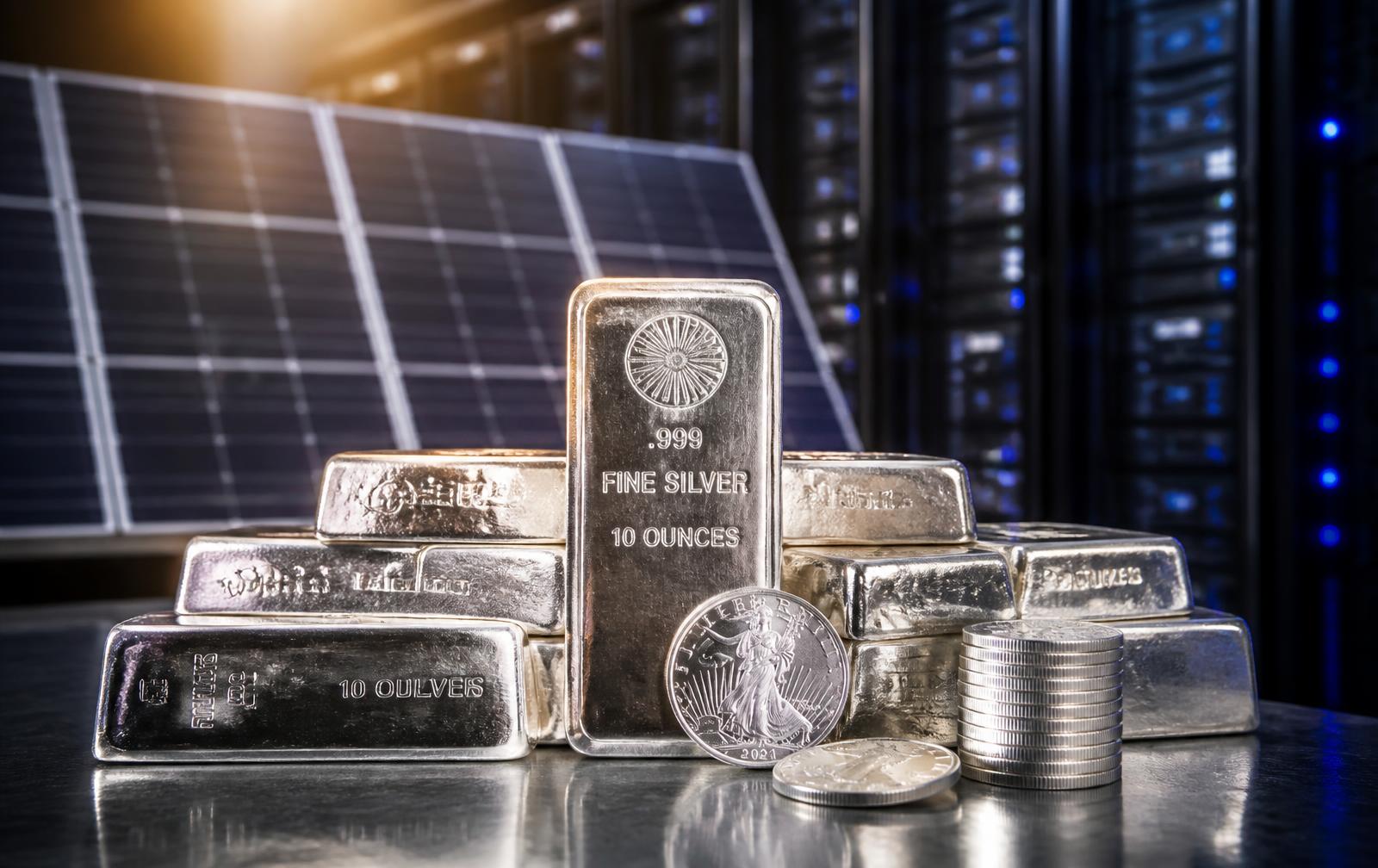
Industrial silver applications shown together: solar cells, electrical contacts and data-centre power equipment
More than half of annual silver demand is industrial, per the Silver Institute: solar cells, electrical contacts, brazing alloys, vehicles and the power plant behind computing.
Describe this illustration: Industrial silver applications shown together: solar cells, electrical contacts and data-centre power equipment

The plate collects the documented industrial uses of silver rather than the speculative ones. Silver has the highest electrical and thermal conductivity of any metal, which is why it appears in photovoltaic paste, switchgear contacts, brazing alloys, and electronics throughout vehicles and computing hardware. Solar and electronics consumption is published by the Silver Institute and the USGS. Per-rack data-centre silver figures are not published, and this page does not invent one.
Why supply is slow, and what a deficit means

Most silver is not mined for silver. It arrives as a by-product of lead, zinc, copper and gold operations, whose production decisions follow those metals' economics. A higher silver price therefore does not summon much new supply quickly, and new primary mines take many years to permit and build.

That is the strongest structural fact in the silver case, and it still does not tell you what the price will do. The Silver Institute has reported multi-year structural deficits, meaning demand exceeding mine plus recycled supply, with the gap drawn from above-ground stocks. Those stocks are large and imperfectly measured. Higher prices also increase recycling and encourage thrifting and substitution in industrial designs. A deficit is a description of a flow, not a forecast of a price.

Physical metal versus paper exposure

If you conclude that silver deserves a place, the next question is the form. An ETF share is a claim on a pooled holding: liquid, low-cost, with an expense ratio and generally no delivery right for an ordinary holder. Physical bullion is a holding you can identify, with storage, insurance and a dealer spread attached.

We sell physical metal, which is a conflict you should price into how you read this paragraph. The trade-off is nonetheless real: paper exposure is better for trading and cost, physical is better for direct holding and custody, and the right answer depends on why you want silver at all.

Diagram contrasting a paper silver ETF claim on a pooled holding with delivered physical bullion
An ETF share is a claim on a pooled holding, priced and traded like a security. Physical bullion is a holding with custody, storage and insurance attached. Each has trade-offs.
Describe this illustration: Diagram contrasting a paper silver ETF claim on a pooled holding with delivered physical bullion

On one side, a share class representing an interest in a trust's pooled metal: liquid, cheap to trade, with an expense ratio and no delivery right for an ordinary holder. On the other, allocated physical bullion: identifiable, deliverable, with storage, insurance and a dealer spread. Neither is presented as superior. The trade-offs are liquidity and cost against direct holding and custody.

Product choice usually matters more than timing

Sovereign coins such as the American Silver Eagle carry a higher premium per ounce than a ten-ounce or hundred-ounce bar, because minting, distribution and sovereign backing all cost something. For the same money, a buyer choosing bars over small coins usually acquires meaningfully more metal.

That is a controllable cost, unlike the price of silver. We quote the spot reference and the premium separately, product by product, so the comparison is visible rather than buried in a single number.

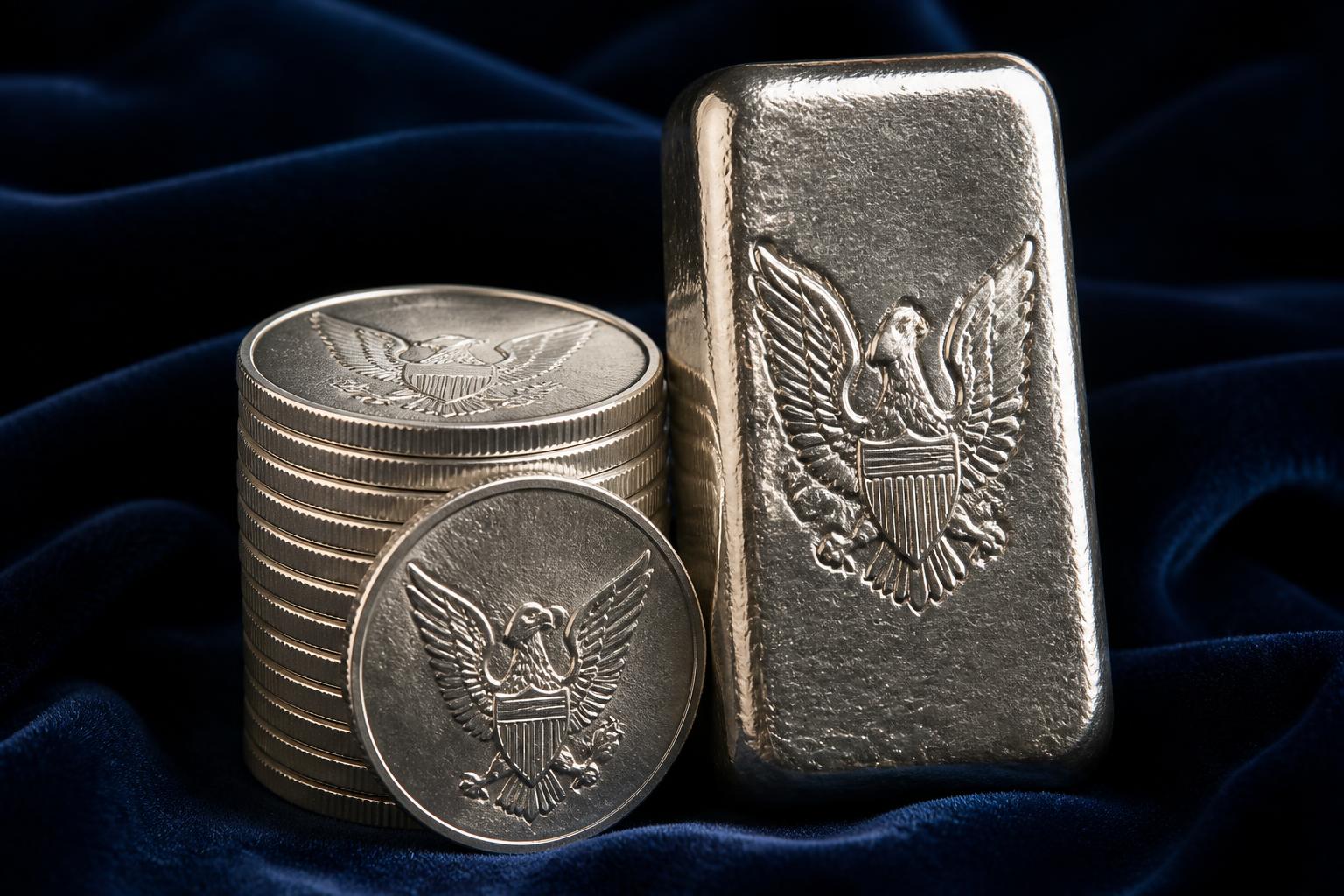
American Silver Eagle coins and a ten-ounce silver bar photographed close up
Physical silver, product by product: sovereign coins carry a higher premium than a ten-ounce bar, and product choice usually affects your cost more than timing does.
Describe this illustration: American Silver Eagle coins and a ten-ounce silver bar photographed close up

Close-up bullion photography showing the two ends of the physical market: government-minted one-ounce coins such as the American Silver Eagle, and larger poured or minted bars. Coins cost more per ounce because of minting and sovereign backing; bars cost less per ounce and are simpler to store in quantity. Capstone Metals quotes the spot reference and the premium separately so the difference is visible.

How much, and the discipline of not answering that for you

Published institutional discussion of precious-metals allocation ranges widely and depends entirely on objective, horizon and income needs. We do not publish a single recommended percentage, because the share that fits a retired household drawing income is not the share that fits a saver twenty years out.

What we will say is that concentration is the risk that hurts people. Metals are usually discussed as a portion of a portfolio rather than a replacement for one.

Portfolio diagram showing a modest precious-metals share balanced against other holdings
Metals are usually discussed as a share of a portfolio rather than a replacement for one. The right share depends on the household, not on a headline.
Describe this illustration: Portfolio diagram showing a modest precious-metals share balanced against other holdings

A balance diagram placing a precious-metals allocation next to other holdings. Published institutional discussion of metals allocation ranges widely and depends on objective, time horizon and income needs. Capstone Metals does not publish a single recommended percentage, because the number that fits a retired household with income needs is not the number that fits a saver two decades from retirement.

The case against, stated properly

If these points do not change your view, at least you have considered them.

  • Silver pays no income. The entire return depends on the price when you sell.
  • Industrial demand ties silver to the economic cycle, so recessions can hit it from both directions.
  • Thrifting and substitution are real: solar cells now use less silver per watt than they did.
  • Above-ground stocks are large and imperfectly measured, which weakens simple deficit arguments.
  • Premiums and spreads must be recovered before a physical holding is level.
  • Storage, insurance and delivery all cost money or attention.
  • A critical-mineral designation is a policy statement about supply risk, not a forecast.

Questions people actually ask

Why is silver called a critical mineral?

The United States added silver to its 2025 final List of Critical Minerals. A listing reflects assessed supply risk and economic importance — including reliance on imports and on by-product supply — rather than an expectation about price. We do not claim other governments made the same designation; the country-by-country comparison is on our critical-minerals page with list years.

Does AI demand mean silver must rise?

No, and we will not argue it. Electronics and electrical applications already consume hundreds of millions of ounces annually, and computing infrastructure is growing, but per-rack silver figures are not published in primary sources. A directional argument is not a quantity, and a quantity would still not be a price forecast.

What is a silver supply deficit?

Demand exceeding mine supply plus recycling in a given year, with the difference drawn from above-ground inventories. The Silver Institute — an industry body — has reported several consecutive deficit years. It describes a flow. Inventories are large and imperfectly measured, and higher prices increase recycling and encourage substitution.

Why can't miners just produce more silver?

Because most silver is a by-product of lead, zinc, copper and gold mining, so its output follows those metals' economics rather than the silver price. Primary silver mines exist but take many years to permit and build. This is the structural reason supply is slow to respond, and it is documented by the USGS.

Is silver better than gold?

They do different jobs. Gold is the steadier monetary metal with far less industrial exposure; silver is more volatile and more tied to the economic cycle. Which fits depends on whether you want stability or industrial-plus-monetary exposure. Anyone who answers this question without asking about your objective is guessing.

How is silver priced when I buy physical metal?

Spot plus a premium that varies by product, then a spread when you sell. Coins carry higher premiums per ounce than large bars. We quote spot and premium separately, and we publish how precious-metals pricing works so the anatomy of a quote is visible before you ask for one.

Read further on our research pages

If a retirement account is part of the question

Read the research first. The retirement-account mechanics are a separate page, offered only if that is where you are.

Retirement-account mechanics

Sources

Get the strategic silver research, or ask a specialist

The guide collects the supply, demand and policy evidence with sources named and dated, including the parts that argue against owning silver. If you would rather talk it through, call or text and a licensed specialist will answer.

Disclosures

Who you are dealing with. Capstone Metals is a DBA (“doing business as”) name of TB Alternative Assets LLC, a California-registered company. TB Alternative Assets LLC is the legal entity that owns and operates Capstone Metals and is the contracting party on every order, agreement and disclosure on this site. Our office: 5311 Topanga Canyon Blvd, Woodland Hills, CA, 91364. Telephone (800) 200-9553, info@capstonemetals.com. Monday – Friday, 7am – 4pm Pacific.

Market risk. Capstone Metals does not promise or project the future price of any metal. Precious metals are speculative, produce no income, and can be sold for less than you paid. Past performance never guarantees future results, and nothing on this page is a forecast, projection or assurance of any outcome.

Costs. Every physical metals transaction includes a premium over the spot price, and dealer buy and sell prices include a spread. Retirement accounts additionally carry custodian setup, annual administration and depository storage fees set by those independent firms. All applicable amounts are disclosed to you in writing before you commit to anything.

Not advice. This page is education, not investment, tax or legal advice, and it is not an offer or a recommendation. Custodians and depositories are independent third parties, not affiliates of Capstone Metals. Discuss your situation with your own tax professional, attorney and any advisor you trust before acting.

By submitting your name and phone number you are asking us to follow up, and you agree that Capstone Metals may contact you by phone, text, or email to clarify what you are looking for and make sure you receive it. Message and data rates may apply. You can ask us to stop at any time by replying STOP or telling us on the phone, and we never sell or share your information. This is a request for information and a conversation — not a purchase, an application, or advice.

Read the full risk disclosures, disclaimer and privacy policy.

Call (800) 200-9553 Text Email